
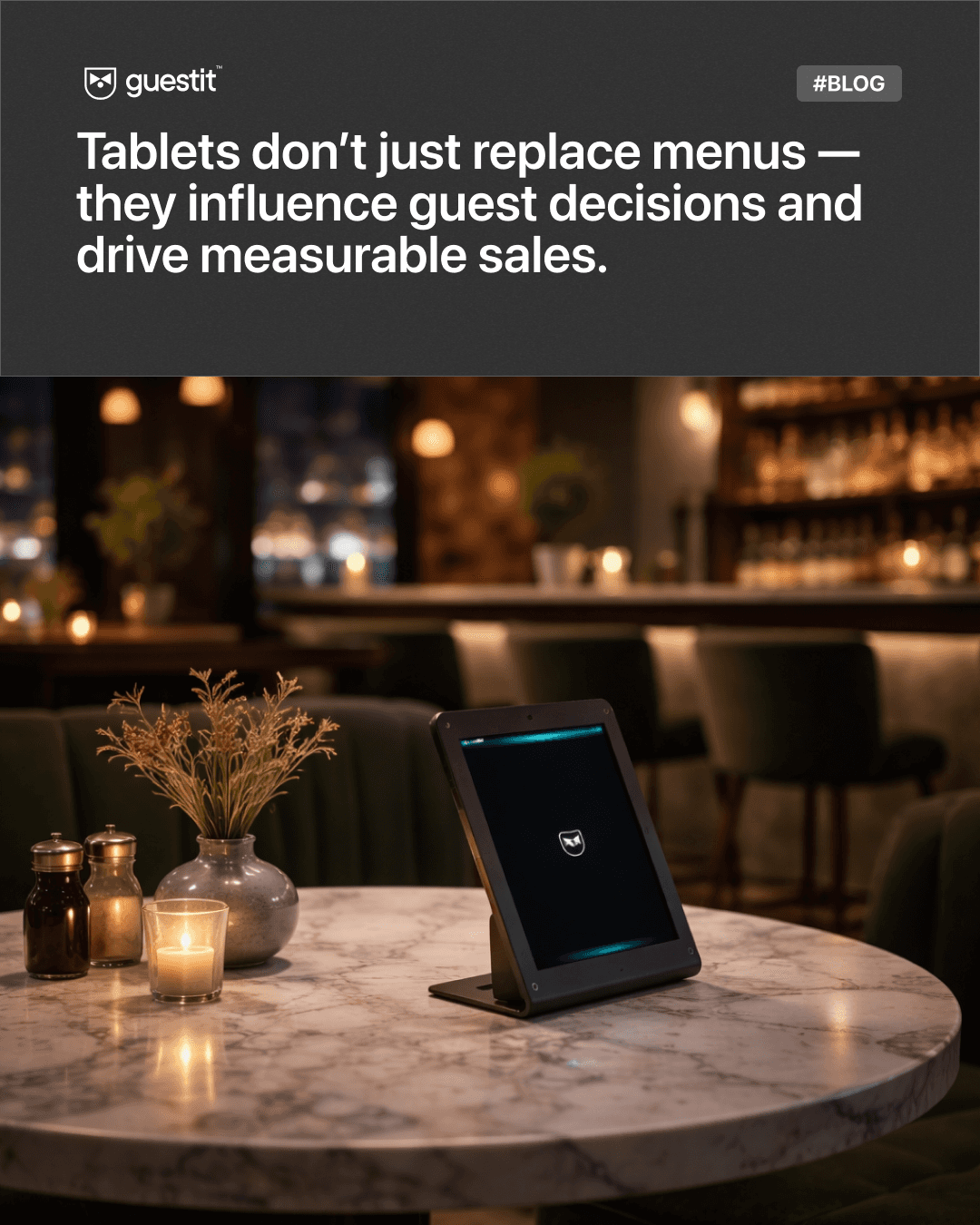
Tablets don’t just replace menus — they influence guest decisions and drive measurable sales.
What restaurants are realizing now is simple:
Tablets are no longer passive tools. They are active sales touchpoints.
The Most Valuable Moment Has Always Been the Table
Guests don’t decide what to order at the entrance.
They don’t decide while scrolling social media.
They decide at the table.
That moment — when guests browse, hesitate, compare, and consider — is where influence actually happens. Traditionally, this moment was left to chance: a waiter’s recommendation, a small printed highlight, or nothing at all.
Tablets change that dynamic.
By being present at the table, they place visual information exactly where decisions are made.
Visibility Changes Behavior
Products that are seen are more likely to be chosen.
Products that are highlighted are more likely to be remembered.
Banners, featured items, and screensavers on tablets increase product visibility without interrupting the guest experience. There is no push, no pressure, no reliance on staff timing. The information is simply there — consistently, calmly, and visually.
This doesn’t force decisions.
It guides them.
Why Tablets Succeed Where Other Promotions Fail
Posters are ignored.
Table talkers blend into the background.
Verbal upselling depends on staff confidence and availability.
Tablets, however, operate differently:
They are already part of the guest journey
They command attention naturally
They remain present throughout the visit
This makes tablet-based promotion one of the few channels that reaches guests at the exact moment of choice.
From Influence to Measurement
The real shift happens when influence becomes measurable.
Unlike traditional in-store promotion, tablet content can be tested and analyzed. By comparing sales data before and during tablet-based campaigns, restaurants can see how increased visibility affects product performance.
This turns tablets into more than a design choice — they become a measurable sales tool.
Idle table time becomes data.
Exposure becomes insight.
Insight becomes action.
The Strategic Role of Tablets Today
Tablets don’t replace hospitality.
They don’t replace staff.
They don’t replace service.
They support decisions where they matter most.
Restaurants that understand this aren’t just digitizing menus — they’re using table time as a strategic sales moment.
Conclusion
Tablets at the table don’t just replace menus.
They influence guest decisions and drive measurable sales.
The future isn’t about adding more screens.
It’s about using the screens you already have — smarter.